This is not an attack on parents.
It is a reflection.
It is an attempt to look honestly at something a lot of people feel but are not always allowed to say out loud: when a child grows up and there is distance, tension, or no real bond with their parents, why is the blame so often placed automatically on the child?
That question should go both ways.
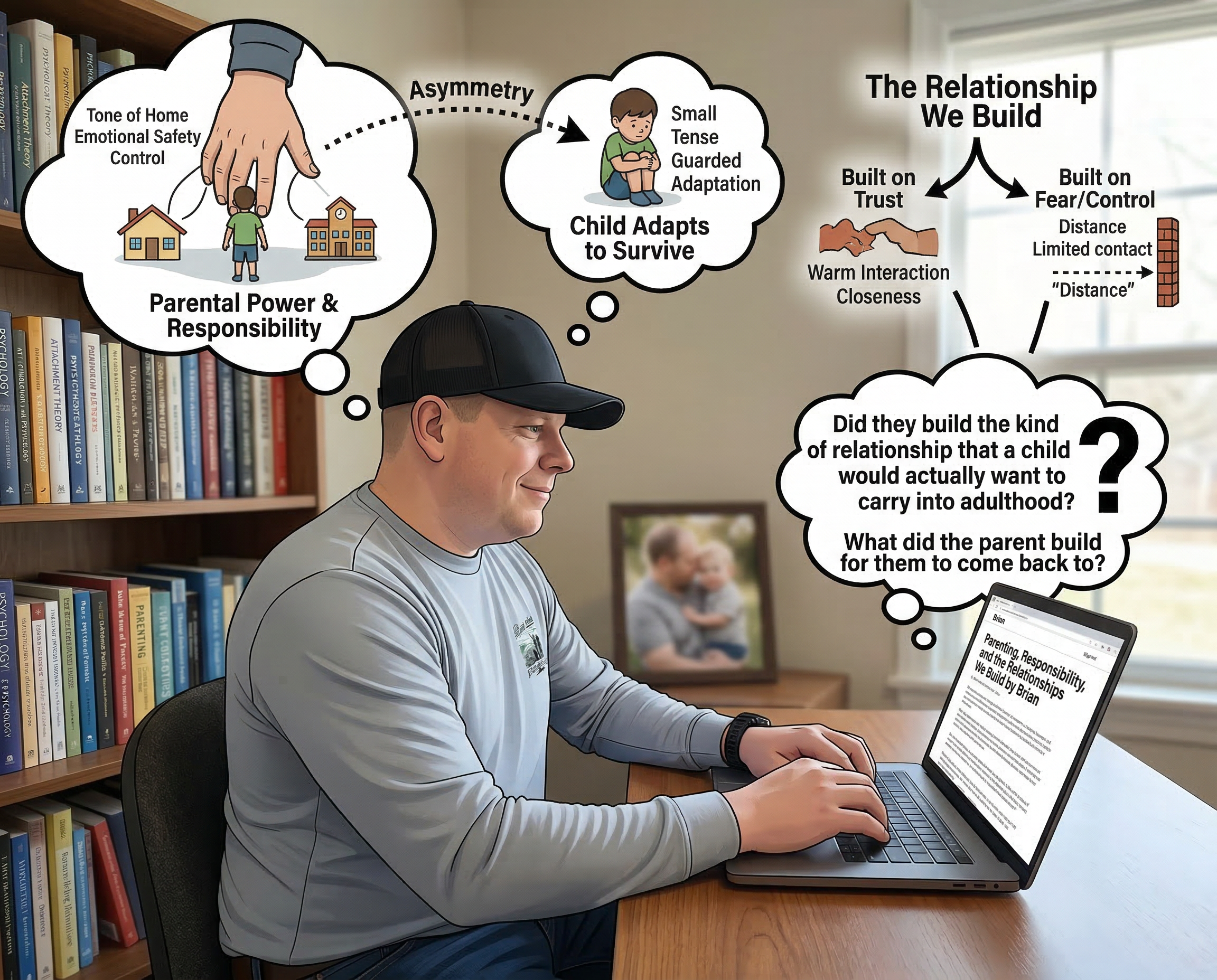
Yes, adults should reflect on how they respond, what boundaries they set, and how they carry themselves. But parents also have to face a harder question: did they build the kind of relationship that a child would actually want to carry into adulthood?
Because that does not happen by accident.
The uncomfortable truth about responsibility
From birth through adolescence, parents control almost everything that matters in a child’s environment.
They control the tone of the home. They control emotional safety. They control whether correction comes with guidance or shame. They control whether problems are met with support or scolding. They control whether a child learns, “This is a safe person to go to,” or “I need to hide parts of myself to survive here.”
Research backs up what common sense already suggests: early relationships and environment matter a lot. The CDC notes that adverse childhood experiences can have long-term negative effects on health, opportunity, and well-being, and those experiences include not only abuse or neglect but also conditions that undermine a child’s sense of safety, stability, and bonding. Harvard’s Center on the Developing Child goes even further, emphasizing that responsive “serve and return” interactions with caregivers play a key role in shaping brain architecture and later development.
That matters because children are not entering a neutral system.
They are being formed inside one.
So when people talk as if the child alone is responsible for the later relationship, that skips over the biggest fact in the room: the parent had the greatest power during the years when the relationship was being built.
“I’m your parent” is not the same thing as “I built trust”
There is a phrase a lot of people hear growing up: “Because I’m your parent.”
Sometimes that is just authority doing its job. Kids need structure. They need boundaries. They need adults who will lead.
But authority alone does not create closeness.
Being the parent does not automatically make you the safe person. It does not automatically make you the trusted person. It does not automatically make you the person your child will call when life falls apart.
That part has to be earned in the day-to-day pattern of the relationship.
Was home a place where emotions were handled with care?
Was failure met with coaching or humiliation?
Could the child tell the truth without feeling like honesty would be punished harder than the mistake itself?
Did the parent know how to listen, or only how to correct?
Those things add up.
Research consistently links parental warmth and relationship quality with better long-term outcomes. One longitudinal NIH-published study found that parental warmth in childhood was associated with greater flourishing in midlife. A 2024 cross-cultural study similarly found that higher recalled parent-child relationship quality was associated with higher adult flourishing and better current mental health.
That is not a small issue. That is the foundation.
Parents have the larger burden early because children have less power
This is where I think culture often gets it backward.
Culturally, people will say things like, “That’s still your mom,” or “That’s still your dad,” or “You owe your parents respect no matter what.”
But respect and access are not the same thing.
Gratitude and closeness are not the same thing.
Title and trust are not the same thing.
A child does not choose the home, the tone, the maturity level of the adults, the emotional skills in the house, or whether their needs are taken seriously. The parent does. The parent chose to bring a child into that environment. The child did not choose it.
That means the responsibility is not equal in the early years. It is asymmetrical.
The parent has more power, more authority, more control, and therefore more responsibility.
That does not mean every parent had endless resources, perfect models, or an easy road. A lot of parents were carrying their own wounds. A lot were overwhelmed. A lot were doing better than what was done to them.
But “I did my best” and “I built a healthy relationship” are not always the same statement.
Those are two different things.
Your best may have been sincere. It may have been all you knew. But if that best still taught your child that you were unsafe, dismissive, volatile, emotionally unavailable, or impossible to please, then you cannot be shocked when the adult version of that child creates distance.
That is not cruelty.
That is consequence.
The relationship window is real
Another hard truth is that the opportunity to build this bond is biggest when children are young.
That does not mean repair is impossible later. It is not. But the years of greatest access, greatest influence, and greatest daily contact do not last forever.
Pew Research found that young adults often do stay in regular contact with their parents, especially through texting and phone calls. But in-person time is far less frequent: only 22% of young adults say they see a parent at least a few times a week, while 42% say they see that parent less than once a month, including 6% who say they never see them. Parents report a similar pattern: frequent digital contact, but much less frequent in-person time.
That matters because once adulthood begins, life starts branching.
Jobs happen. Marriage happens. Kids happen. Geography changes. Priorities split. Energy gets limited.
If a parent spent the dependency years building mostly fear, obligation, criticism, or emotional distance, they should not expect the adult years to magically produce intimacy.
By then, the relationship often reveals what was actually built.
Children remember the role you played
A lot of adults do not stay away from parents because they hate them.
They stay away because they know exactly how they feel around them.
Small. Tense. Guarded. Misunderstood. Managed. Judged. Drained.
If your child learned that coming to you with a problem meant getting lectured, shamed, dismissed, compared, or emotionally punished, then they learned not to come to you. That is not rebellion. That is adaptation.
Attachment research supports the idea that responsive caregiving helps children develop security, while controlling, inconsistent, or hostile dynamics can push things the other direction. A review in the NIH archive notes that responsive and contingent parenting is associated with secure attachment, and that secure attachment is linked with resilience and competence later in life. Another longitudinal study found that supportive maternal behavior predicted increases in attachment security from adolescence into adulthood, while psychological control and hostile interparental conflict predicted decreases.
In plain English, kids remember who felt safe.
And they remember who did not.
Not every parent-child bond survives adulthood, and that does not always mean the child failed
This is one of the biggest points I wanted to make.
When a grown child keeps distance, sets boundaries, limits contact, or does not return emotionally to a parent, culture tends to tell one story first: the child is ungrateful, selfish, rebellious, or cold.
But research and lived experience both suggest that family relationships are more complicated than that. Contact alone does not prove closeness, and more contact is not always a sign of better relationship quality. In one study on later-life intergenerational ties, frequency of contact did not map neatly onto better relational quality; in some situations, more contact was associated with worse relationship quality.
That should not surprise anybody.
Some people call because they want to.
Some people call because they feel guilty.
Some people visit because there is love.
Some people visit because there is pressure.
Some people stay in touch out of bond.
Some stay in touch out of duty.
Those are not the same thing.
Accountability cuts both ways
I think one of the most damaging cultural habits is how selectively we apply accountability.
We are often quick to tell children, even adult children, to forgive, honor, return, tolerate, and endure.
But we are much slower to ask parents whether they were emotionally safe, whether they handled power well, whether they nurtured trust, whether they repaired harm, whether they listened, whether they learned, and whether they took real ownership for what the child experienced.
That imbalance creates a false moral story.
It tells the person with less early power that they owe permanent loyalty to the person with more early power, even if that power was mishandled.
That is backward.
Parents do not have to be perfect. No one is. But they do have to understand the job.
The job was never just food, shelter, and rules.
The job was relationship.
The job was stewardship.
The job was helping shape a human being who felt safe enough to trust you, and strong enough to grow.
Boundaries are not always bitterness
Sometimes the healthiest thing an adult child does is stop pretending that a painful relationship is healthy just because it is biological.
That is not always hate.
Sometimes it is grief with clarity.
Sometimes it is finally naming reality.
Sometimes it is the adult version of saying, “I cannot keep standing in a fire and calling it family.”
That does not mean people should rush to cut others off. It does mean they should be allowed to evaluate relationships honestly. Biology does not erase patterns. Titles do not erase damage. Time does not erase accountability unless there is actual repentance, repair, and change.
And for parents, that should be a wake-up call, not an insult.
If you want a real relationship with your child later, build one now. If now has already passed, start telling the truth, take ownership, and try to repair what is repairable.
But do not demand closeness as tribute for a role you did not carry well.
Final thought
I do not think this conversation needs more rage. I think it needs more honesty.
A child does not owe a parent emotional intimacy just because that parent existed in the role.
A parent’s title does not cancel the parent’s responsibility.
If anything, it increases it.
The years when children are small are not just years of control. They are years of planting. And whatever gets planted there tends to show up later: trust or fear, warmth or distance, honesty or secrecy, attachment or avoidance.
That is why this matters so much.
Not because the goal is to attack parents.
Because the goal is to tell the truth about what relationships are built on.
And if we tell the truth, maybe more people will stop asking only, “Why doesn’t the child come back?”
And start asking the harder, fairer question:
“What did the parent build for them to come back to?”
Sources and further reading
- CDC, “About Adverse Childhood Experiences (ACEs)”
- Harvard Center on the Developing Child, “Serve and Return” and “Brain Architecture”
- Pew Research Center, “Young adults’ relationship with their parents”
- Pew Research Center, “Parents’ relationship with their young adult children”
- Chen et al., “Parental Warmth and Flourishing in Mid-life”
- Rothwell et al., “Parent-child relationship quality predicts higher subjective well-being in adulthood”
- Hong & Park, “Impact of attachment, temperament and parenting on human development”
- Allen et al., “Parent and Peer Predictors of Attachment Security From Adolescence to Adulthood”
- Chai et al., “Revisiting Intergenerational Contact and Relationship Quality in Later Life”