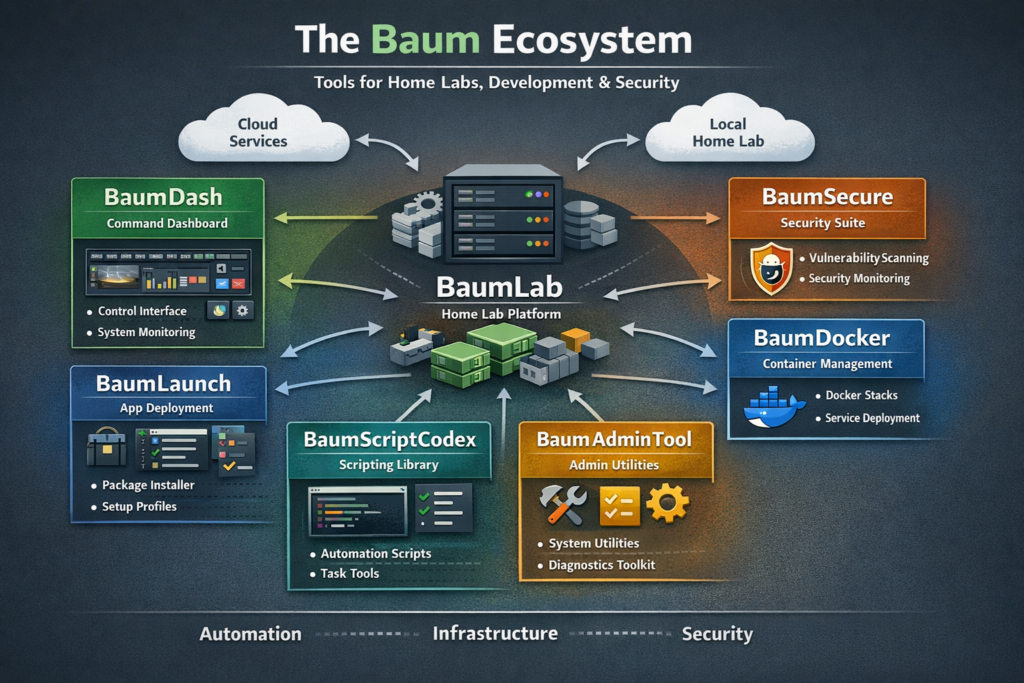
One of the things that’s been most fun about publishing these projects is realizing that they aren’t isolated tools. Over time they’ve started forming a small ecosystem of utilities designed to work together.
Each project focuses on a different layer of the same idea: building a modern toolkit for developers, home lab enthusiasts, and system administrators who enjoy experimenting with infrastructure and automation.
Some projects focus on interfaces, some focus on deployment, and others focus on security, scripting, or administration. Together they form a growing collection of tools that support both learning and real-world experimentation.
Here’s a closer look at the projects currently in the repository. https://github.com/Bruiserbaum
BaumDash
A Personal Command Dashboard
BaumDash is one of the flagship projects and serves as the visual control surface for many of the tools in the ecosystem.
It’s designed to run as a persistent dashboard on Windows, especially on a secondary ultrawide or touchscreen display mounted above or below a primary monitor.
Instead of constantly switching between tools, BaumDash creates an always-visible control panel where you can monitor systems and interact with services.
Features include:
- System audio controls and device switching
- Per-application volume control
- Media playback integration
- System performance monitoring
- Weather information
- Discord activity integration
- AI chat interfaces for local or cloud models
- Calendar visibility
- Home Assistant smart home controls
- Quick-launch tiles for applications and scripts
- Embedded dashboards and status panels
The goal is to create something that feels like a command console for your workstation and infrastructure.
BaumLab
A Home Lab Platform
BaumLab focuses on the infrastructure side of the ecosystem.
It’s designed as a container-based home lab management environment built around Docker. The goal is to create a central platform where you can organize, deploy, and experiment with services running in your lab.
BaumLab helps bring structure to environments that often grow chaotic over time.
It can support things like:
- containerized services
- infrastructure documentation
- system monitoring
- vulnerability scanning tools
- network experimentation
- development sandboxes
BaumLab essentially becomes the backend platform for many of the tools that BaumDash interacts with.
BaumDocker
Simplifying Container Environments
As the ecosystem grew, Docker became a major part of how these services are deployed and tested.
BaumDocker focuses on simplifying the process of managing container environments and deploying infrastructure components.
This project explores ways to standardize:
- container configurations
- development environments
- service stacks
- deployment patterns
It acts as a bridge between experimentation and structured infrastructure.
BaumSecure
Exploring Security and Vulnerability Awareness
Security is a major part of any modern infrastructure environment, especially when experimenting with services in a home lab.
BaumSecure is focused on exploring tools and concepts around:
- vulnerability awareness
- system security monitoring
- infrastructure hardening
- threat visibility
Rather than being a single security product, it’s more of a platform for experimenting with security tooling and best practices within a lab environment.
BaumLaunch
A Visual Package and Application Launcher
Another project in the ecosystem is BaumLaunch, which focuses on simplifying how systems are configured and applications are installed.
The idea behind BaumLaunch is to provide a graphical interface for managing application installations and launch configurations, often built around tools like WinGet.
Instead of installing applications one at a time or remembering commands, BaumLaunch allows users to create structured installation profiles and quickly configure environments.
It’s particularly useful when setting up new machines or standardizing toolkits across systems.
BaumScriptCodex
A Library of Scripts and Automation
As any system administrator knows, scripts are the backbone of automation.
BaumScriptCodex is a curated collection of useful scripts designed for system management, troubleshooting, automation, and experimentation.
The Codex serves as a kind of knowledge base of operational tools, allowing scripts to be cataloged, documented, and reused across different environments.
Over time it becomes a growing library of solutions for common administrative tasks.
BaumAdminTool
Quick Utilities for System Administration
BaumAdminTool focuses on a practical goal: creating a portable toolkit for system administrators.
The idea is to provide a unified interface that allows admins to quickly perform common tasks such as:
- viewing system information
- running diagnostics
- executing common repair commands
- applying configuration changes
- launching troubleshooting utilities
Rather than digging through multiple tools or command prompts, BaumAdminTool provides a centralized utility interface for everyday administrative operations.
How the Projects Work Together
What’s interesting about these repositories is that they naturally fall into layers.
Think of it like a stack:
Interface Layer
Tools designed for visual interaction and monitoring
- BaumDash
Infrastructure Layer
Platforms that run services and systems
- BaumLab
- BaumDocker
Security Layer
Tools focused on visibility and protection
- BaumSecure
System Management Layer
Tools for provisioning, automation, and administration
- BaumLaunch
- BaumScriptCodex
- BaumAdminTool
Together these tools form a personal experimentation platform for modern infrastructure and development workflows.
Some of the tools interact directly, while others simply support the same ecosystem.
And because they’re all published openly, they can evolve organically as new ideas come along.
A Playground for Building
The biggest thing these projects represent isn’t a finished platform.
It’s a playground for building.
Each repository is a place to test ideas, try new approaches, and experiment with how modern infrastructure, automation, and interfaces can work together.
Some of the tools will grow into larger platforms.
Others will remain small utilities.
But together they reflect something that’s easy to forget in professional technology environments:
Sometimes the most important thing you can do is just build something interesting and see where it goes.