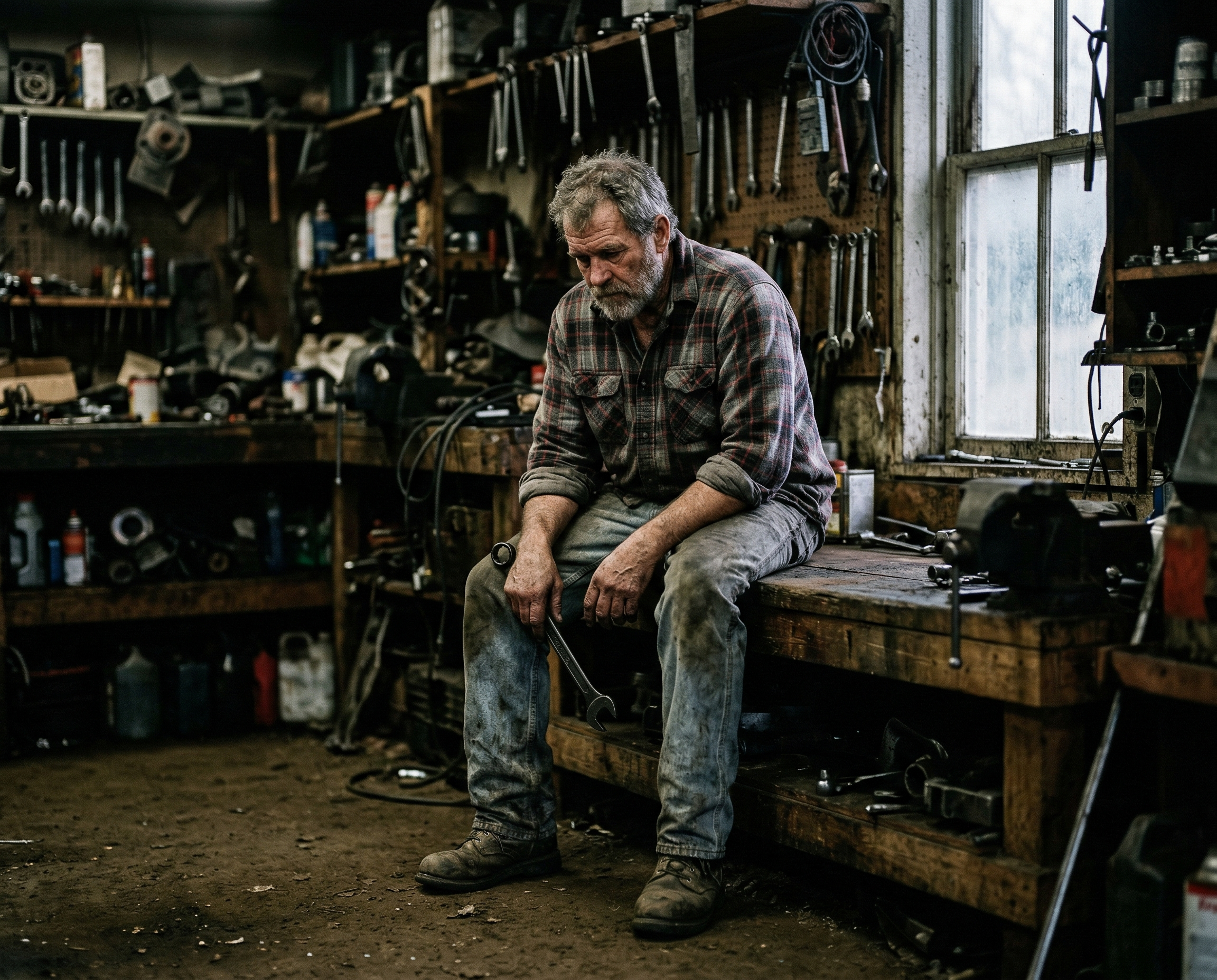
There is a version of manhood that a lot of us were raised in, and it starts early.
Do not cry.
Do not complain.
Do not look weak.
Do not talk too much about your feelings.
Be useful.
Be tough.
Protect people.
Provide.
Lift the heavy thing.
Do the dangerous job.
Take the hit.
Rub some dirt on it and keep moving.
A lot of boys, especially white boys in America, were raised with that script whether anyone ever said it out loud or not. It showed up in households, in sports, in schools, in church, in work, and in culture. The message was clear: your worth is tied to what you can carry, fix, endure, and provide.
Then many of those same boys grew into men and ran into a different message from modern culture: you are privileged, your struggles are less important, your voice is suspect, and your pain is probably just a refusal to recognize how easy you have it.
That disconnect is real.
And it is one reason this conversation matters.
This is not an attack on anyone else’s hardship. It is not a denial that race, class, sex, and social background can shape opportunity in different ways. But there is a serious mistake in the way we talk about men, especially white men, when we act like any statistical advantage in one area means emotional suffering in another area is not real. That is lazy thinking, and it is costing people their lives.
The truth is simpler and uglier: a lot of men were raised to suppress emotion, solve problems alone, and keep functioning no matter what. Then when they finally try to speak honestly about loneliness, pressure, anger, shame, or exhaustion, they are often met with dismissal instead of understanding.
That is not helping anybody.
The boyhood many men were trained into
A lot of men did not grow up being taught emotional fluency. They grew up being taught emotional control.
Those are not the same thing.
Emotional fluency means learning how to name what you feel, process it, communicate it, and seek support without shame. Emotional control, as many boys were taught it, often meant stuffing feelings down until they became numbness, irritability, withdrawal, or explosive anger.
The American Psychological Association has explicitly noted that boys and men are often shaped by restrictive masculine norms, including self-reliance, emotional restriction, and pressure to appear strong. Research has repeatedly linked stronger endorsement of traditional masculinity to more negative attitudes toward getting psychological help and more self-stigma about seeking it.
That matters, because it means a lot of men are not refusing help because they do not hurt. They are refusing help because they were trained to believe needing help is failure.
There is also growing evidence that boys often start out emotionally open and deeply connected in friendships, but become more guarded as they age because of cultural pressure. Developmental research summarized by Harvard’s Graduate School of Education argues that boys do not disconnect from their emotional lives because of some built-in defect; they disconnect because the culture around them teaches them to.
That should stop us in our tracks.
If boys are taught early that vulnerability is dangerous, then adult male isolation is not some random mystery. It is a predictable outcome.
The expectation to protect, provide, and endure
Many men are still raised with a role-based identity. You protect. You provide. You keep things working. You take the physical risk. You take the social pressure. You carry responsibility quietly.
Even today, men are more likely to work in many of the most physically dangerous occupations, and they are still socially expected in many homes and communities to be the ones who handle the hard, dirty, heavy, or risky jobs. They are also still required to register for Selective Service in the United States. That does not mean women have it easy. It does mean that traditional expectations on men never disappeared just because the culture started using the word “privilege” more often.
A lot of men live in a contradiction: they are told they are socially powerful while feeling personally disposable.
That tension does damage.
It creates a version of adulthood where a man can be needed by everyone and understood by almost no one.
“Privilege” is a bad substitute for listening
This is where the conversation usually goes off the rails.
The moment many men try to describe what they are carrying, someone jumps in with a slogan. White privilege. Patriarchy. Male privilege. Check your privilege. Stop centering yourself.
Sometimes those ideas are being used to point to real social patterns. Fine. But when they are used as a reflex to shut down lived experience, they stop being analysis and start becoming a muzzle.
You do not build a healthy society by telling whole groups of people that the moment they speak about pain, their pain is automatically less valid.
You do not reduce polarization by mocking vulnerability.
You do not reduce suicide by making honesty socially expensive.
A person can have advantages in some parts of life and still be drowning in others. Those things are not mutually exclusive. A white man may not face some barriers other groups face, but that does not magically protect him from depression, addiction, divorce, isolation, purposelessness, trauma, or despair. Treating him like it does is not compassion. It is ideology.
The suicide numbers should force this conversation to be more honest
The most damning proof that something is badly wrong is the suicide data.
According to the National Institute of Mental Health, in 2023 the U.S. suicide rate for males was 22.8 per 100,000, compared with 5.9 for females, meaning men died by suicide at nearly four times the rate of women.
When broken down by race and ethnicity, the 2023 age-adjusted suicide rate for non-Hispanic White males was 28.0 per 100,000. That was lower than the rate for non-Hispanic American Indian/Alaska Native males at 35.3, but much higher than rates for Black males at 15.1, Hispanic males at 13.3, and Asian/Pacific Islander males at 10.3.
So the honest statement is this: white men are not the highest-risk male group overall, but they are one of the highest, and because they also make up a large share of the U.S. population, they account for a tremendous amount of suicide loss. That is not a talking point. That is a national crisis.
There is more. Among males overall, the highest suicide rate in 2023 was among those age 75 and older, at 40.7 per 100,000. Rates were also extremely high among men ages 25–44 and 45–64.
And although CDC reporting shows some decline in overall suicide rates among White persons in recent years, it also shows significant increases among White adults age 65 and older, and it makes clear that suicide trends differ sharply by age and race rather than fitting one simple narrative.
That is why shallow cultural language fails here. If a group is supposedly so fully insulated by privilege, why are so many of its men dying in despair?
That question deserves more than a sneer.
Men often try to solve pain instead of naming it
Another uncomfortable truth: many men are wired by training, habit, and expectation to respond to distress by fixing, not expressing.
That does not mean men are emotionless. It means many men have learned to convert emotion into action. They mow the yard. Fix the truck. Work another shift. Lift weights. Drink. Shut down. Distract themselves. Try to outwork the pain. Try to solve what is actually a wound.
Sometimes that problem-solving tendency is useful. It can make men dependable in crisis. It can make them calm under pressure. It can make them builders, responders, providers, and protectors.
But it can also become a trap.
Not every human problem can be solved like a broken appliance. Grief cannot be repaired with a wrench. Shame does not disappear because you stayed busy. Loneliness does not always lift because the bills are paid. And when a man has been taught that his value is tied to usefulness, he may feel like he is disappearing the moment he cannot perform.
Research on men’s help-seeking consistently finds that stronger traditional masculinity norms are associated with more self-stigma and less willingness to get psychological support.
That means many men are not merely suffering. They are suffering while feeling morally obligated to hide it.
The isolation problem nobody wants to name
A lot of men have friends, coworkers, teammates, or family around them and still feel profoundly alone.
Why?
Because many male relationships are built around activity rather than disclosure. Men will work together, game together, watch sports together, build together, joke together, and help each other move furniture without ever saying the sentence they actually need to say: “I’m not doing well.”
For many men, emotional closeness feels risky, unfamiliar, or embarrassing. Not because they are incapable of it, but because they were trained out of it.
That isolation gets worse when public discourse treats men primarily as a problem to be managed rather than people to be understood. The more a culture talks about men only in terms of danger, privilege, or blame, the harder it becomes for hurting men to believe anybody actually wants them to speak honestly.
Then we act surprised when they go silent.
We should not be surprised.
We built the silence.
This is not about blaming women or competing in victimhood
Let me be clear. This argument should not turn into “women have it easy” or “other groups do not struggle.” That is nonsense.
Everybody carries pain. Different groups face different burdens. There is no prize for turning suffering into a contest.
But compassion has to work in all directions or it is not compassion at all.
A culture that says it cares about mental health should be able to hear men too. A culture that says it values vulnerability should not punish it when it comes from the “wrong” people. A culture that wants healthier families, healthier marriages, healthier workplaces, and healthier communities should care deeply about the emotional lives of men, because men do not suffer in isolation. Their suffering spills into everything around them: relationships, children, work, addiction, violence, health, and sometimes death.
So what do we do with this?
First, we stop mocking male pain.
Second, we stop pretending that telling men to “open up” is enough if the moment they do, we minimize what they say.
Third, we teach boys emotional vocabulary as seriously as we teach them discipline and responsibility.
Fourth, we stop framing help-seeking as weakness. For many men, asking for help is not a natural first move. It is a learned skill that has to be deliberately normalized.
Fifth, we make room for a version of masculinity that keeps the good without keeping the damage. Responsibility, courage, sacrifice, protectiveness, and competence are not bad traits. The problem is when they are fused to silence, shame, and emotional exile.
Men do not need to become less human to be good men. They need permission to be fully human in the first place.
Final thought
A lot of white men grew up with a simple bargain: be strong, be useful, be quiet.
That bargain may produce hard workers. It may produce protectors. It may produce men who can endure more than most people realize.
It also produces loneliness. It produces emotional illiteracy. It produces men who do not know how to ask for help until they are already breaking. And sometimes, it produces funerals.
If we want a healthier society, this cannot be one of those topics where only approved groups are allowed to hurt out loud.
We need the courage to say something obvious: many men are not okay, and dismissing them is making it worse.
That is not anti-anyone.
It is just honest.